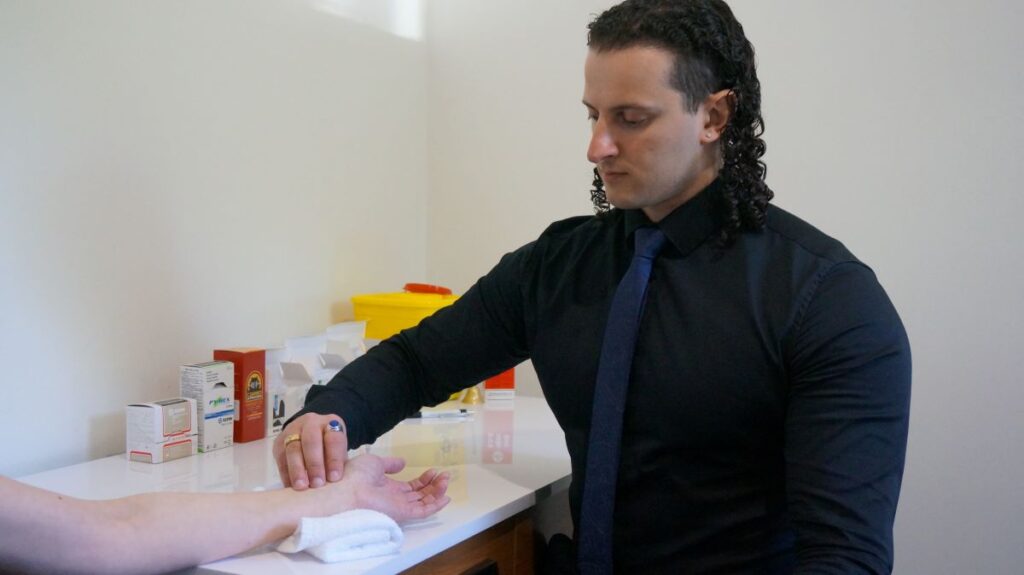
Chinese Pulse Diagnosis
Acupunture And Chinese Pulse Diagnosis
We are located in Moonee Ponds
Wondering if acupuncture is the right therapy for you? We get it!
Using this ancient technique in our modern TCM practice, pulse diagnosis remains a vital tool despite advancements in medical technology. It provides a direct connection to the body’s internal states, offering insights that can sometimes be missed by contemporary diagnostic equipment.
So what can acupuncture and our diagnosis tools help you with?
Below is the specialised acupuncture treatments that we have developed over the past 20 years.
If you need help with Reducing Pain, Anti Aging, Reducing Stress, Balancing Hormones Or Falling Pregnant…. You are in the right place!

An Ancient Art Form to Diagnose Modern Health Problems
We take your radial pulse (on your wrist) to determine the subtleties of blood flowing through your radial artery. We use the pulse determine exactly where the issues lie within your body and how best to treat your health problems.
The art of Chinese pulse diagnosis has largely been lost and is not taught in any depth at Chinese medicine schools and is simply not fully utilised by many practitioners.
Pulse Diagnosis Is A Powerful Diagnostic Tool
Come and talk to us about your health problem for free. We’ll let you know if and how acupuncture can help you. It is a great way for you to speak with a Doctor of Chinese medicine about your health concerns so you can decide if you would like to then book in for treatment.
The Basics of Pulse Diagnosis
We assess a patient’s condition by examining the pulse at the radial artery. Unlike Western medicine, which typically focuses on measuring the rate and rhythm of the pulse, TCM practitioners analyze a variety of pulse qualities to gain a comprehensive understanding of the body’s state.
In TCM, the pulse is felt at three positions on each wrist, corresponding to different organs and aspects of health. These positions are:
- Cun (inch) position: Closest to the wrist crease.
- Guan (gate) position: Middle position.
- Chi (foot) position: Closest to the elbow.
Each of these positions is further examined at three depths: superficial, middle, and deep, providing a total of nine pulse readings per wrist. Practitioners use these readings to evaluate the state of Qi (energy), blood, Yin (substance), and Yang (function) in the body.
Pulse Qualities
There are over 28 distinct pulse qualities that TCM practitioners are trained to identify. Some of the most common pulse types include:
Floating Pulse (Fu Mai)
- Characteristics: Felt strongly at the superficial level and weak at deeper levels.
- Indications: Often associated with exterior conditions like colds or flu.
Deep Pulse (Chen Mai)
- Characteristics: Felt only at the deep level.
- Indications: Indicates interior conditions, such as problems with internal organs.
Rapid Pulse (Shu Mai)
- Characteristics: Faster than normal.
- Indications: Usually indicates heat in the body, which could be due to fever, inflammation, or an overactive metabolism.
Slow Pulse (Chi Mai)
- Characteristics: Slower than normal.
- Indications: Often indicates cold conditions, which could be due to a slower metabolism or poor circulation.
Slippery Pulse (Hua Mai)
- Characteristics: Feels smooth and flowing, like beads rolling on a plate.
- Indications: Common in conditions of phlegm, dampness, or excess heat. It can also be seen in pregnancy.
Choppy Pulse (Se Mai)
- Characteristics: Feels rough and jagged, like a knife scraping bamboo.
- Indications: Often associated with blood stasis or deficiency.
Diagnostic Process
The diagnostic process in pulse diagnosis is meticulous and requires significant training and experience. Our practitioners use their fingertips to palpate the pulse, often spending several minutes on each wrist to gather comprehensive data and interpret the pulse qualities in the context of the patient’s overall symptoms and health history.
Integrating Pulse Diagnosis with Other TCM Practices
Pulse diagnosis is rarely used in isolation. It is typically integrated with other diagnostic methods such as tongue diagnosis, observation, and patient interviews. This holistic approach allows our Chinese Medicine practitioners to form a complete picture of the patient’s health, for a personalised treatment plans that may include acupuncture, herbal medicine, dietary recommendations, and lifestyle changes.